The publication of scientific research findings in academic journals included in biometric databases is taken into account when both defending academic degrees and obtaining academic titles in the Republic of Kazakhstan.

Web of Science is a website that provides access to multiple databases and citation data across 256 disciplines (science, social sciences, arts, and humanities). Access is granted by subscription. The Web of Science Core Collection is the largest scientific citation database. It contains information on more than one billion bibliographic references. Each cited source is carefully indexed, so both the source itself and the original publication are searchable. Web of Science indexes not only articles, but also conference materials and books. This database also covers research, patents, and standards.
WoS is the only resource that stores and indexes data on cited sources dating back to 1900.
Copyright belongs to Clarivate Analytics.

Scopus is the largest curated single database containing abstracts and citation information for peer-reviewed scientific literature, and includes built-in tools for tracking, analyzing, and visualizing data. The database consists of 23,700 publications from 5,000 international publishers across the fields of natural sciences, social sciences, humanities, engineering, medicine, and the arts.
- More than 23,700 publications (including over 4,000 open-access journals)
- 280 specialized publications
- More than 166,000 books (with an additional 20,000 books added annually)
- More than 560 book series
- Over 8.3 million conference papers (from 100,000 international conferences)
- Articles in pre-publication stage (“Articles-in-Press”) from 8,000 journals
More than 71 million records:
- 64 million records since 1969 (including references)
- Over 6.6 million records prior to 1970, with the earliest dating back to 1788
- More than 39 million patent records from five major global patent offices
It covers three types of sources: book series, journals, and trade publications. Searches performed in Scopus also include patent database searches. The total number of records is about 69 million. The time coverage is from 2004 to the present.
Copyright belongs to Elsevier B.V.
SciVal is an online platform used for monitoring and analyzing international scientific research using visualization tools and modern metrics of citation impact, as well as economic and social effectiveness. SciVal provides access to research results from over 20,500 research institutions and their associated researchers across 234 countries worldwide.
The modular SciVal platform enables the presentation and evaluation of research performance for more than 12,000 organizations (universities, government, and corporate research centers) from 230 countries. It also allows organizations and their leaders to optimize strategic investments, effectively determine future research directions, as well as make informed decisions when selecting staff and partners.
SciVal offers a wide range of industry-standard and easy-to-interpret metrics, including Snowball Metrics. These metrics help organizations assess performance indicators, citation impact, and collaboration at the institutional or country level.
The data source for SciVal is the Scopus database—the largest database of abstracts and citations of peer-reviewed literature.
SciVal features one of the most detailed classifications of science: 48 million publications are grouped into 96,000 dynamically developing research topics, which are ranked by prominence (relevance and level of attention) across global science.

Google Scholar – Google Scholar is a free, accessible web search engine that indexes the metadata of scholarly literature across a wide range of publication formats and disciplines.
Released in beta in November 2004, Google Scholar includes a number of peer-reviewed online academic journals, as well as books, conference papers, theses and dissertations, preprints, abstracts, technical reports, and other scholarly literature, including court opinions and patents.
Owner: Google

Dimensions is a scientometric search and analytics platform that contains information on scientific publications, clinical studies, grants, and patents. The scientific content in Dimensions consists of multidisciplinary full-text and abstract scholarly documents, which are available either through open access or via subscription.
The platform includes built-in tools for searching, filtering, and analyzing publications, allowing users to track the level of interest in any given research topic.
RSCI (Russian Science Citation Index) is a bibliographic database of scientific publications by Russian researchers and a citation index for scholarly articles. It is designed to provide researchers with up-to-date reference and bibliographic information. It also serves as a powerful tool for evaluating the productivity and effectiveness of research organizations and scientists, and accurately determines the quality and impact of academic journals.
RSCI makes it possible to assess research performance based on objective data and to conduct a detailed analysis of the publication activity statistics of more than 600,000 Russian scientists and 11,000 research organizations across all fields of knowledge. The system’s chronological coverage is from 2005 to the present, although for many sources the archive goes further back. Every day, more than 3,000 new publication records by Russian researchers are added to RSCI. RSCI has agreements with Clarivate Analytics and Elsevier, allowing users to query the Web of Science and Scopus databases directly and obtain current citation metrics from them. As a result users can simultaneously see the number of citations of a publication in RSCI, Web of Science, and Scopus within the RSCI interface. This free feature is available to all authors registered with RSCI.
Registration in RSCI
To register a new user, you must visit the eLIBRARY website. Then, fill in the required fields:
Full name
Gender, date of birth
Organization and department name
Country and city
Position, email, etc.
After completing the registration form, an activation code will be sent to your email. This will grant you access to the system. Within ten days, access to all database features will be enabled.
The RSCI database offers users two identification methods:
- Author ID: this is how the system identifies the user. It allows authors to publish articles in journals and other publications, as well as participate in events and grant competitions.
- SPIN code: this code allows authors and researchers to link publications to a personal profile, as well as edit, translate, and review texts.
These tools help authors navigate and access information within the electronic bibliographic system. Author ID is available upon registration, while the SPIN code can be obtained in the “Personal Account” section. The second code can only be obtained after the first one has been assigned.
How to find your citation index in RSCI
On the eLIBRARY platform, you can obtain free access to the Russian Science Citation Index (RSCI). To search for a specific publication and determine your citation index, follow these steps:
- Register on the platform.
- Proceed to the RSCI interface.
- Enter the author’s initials in the search bar.
- Specify the journal title, organization, and any other search parameters.
Citation metrics will be calculated automatically.

Научная электронная библиотека eLIBRARY.RU – это крупнейший российский информационно-аналитический портал в области науки, технологии, медицины и образования, содержащий рефераты и полные тексты более 34 млн научных публикаций и патентов, в том числе электронные версии более 5600 российских научно-технических журналов, из которых более 4800 журналов в открытом доступе.

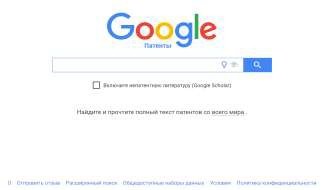
Google Patents is a search engine from that indexes patents and patent applications.
Google Patents includes over 120 million patent publications from more than 100 patent offices worldwide, as well as many other technical documents and books indexed in Google Scholar and Google Books, along with documents from the Prior Art Archive. Full-text descriptions and claims are available for many of these documents.
Currently, Google Patents indexes full-text documents from the following patent offices:
- United States
- Europe
- Japan
- China
- South Korea
- WIPO (World Intellectual Property Organization)
- Russia
- Germany
- United Kingdom
- Canada
- France
- Spain
- Belgium
- Denmark
- Finland
- Luxembourg
- Netherlands
- Austria
- Australia
- Brazil
- Switzerland
- Taiwan
These documents include the complete collection of granted patents and published patent applications from each database (all in the public domain). U.S. patent documents date back to 1790, while EPO (European Patent Office) and WIPO documents date back to 1978.
Search Methods
- Users can type text directly into the search bar. The search engine breaks the query into individual keywords and searches for them in the text, similar to Google web search (go to the Smart Search tab to learn more).
- Users can search for a patent using keywords in the metadata, such as inventor name, patent publication date, or the country where the patent was published (click the Advanced Search tab to learn more).
- Users can enter the patent or application publication number directly.
Search results include the full text, drawings, original PDF versions, metadata, and citations.